The First Thirty Minutes Matter More Than the Next Three Days
When you discover standing water around the dishwasher, the order of operations is simple but easy to get wrong under stress. Kill the power to the kitchen at the breaker before you start mopping, because dishwasher leaks frequently pool around the junction box at the base of the unit and you do not want to find that out the hard way. Then shut off the dedicated supply valve, which on most Alexandria homes sits under the kitchen sink with a small lever or knob feeding a braided line to the left. If you cannot find a local shutoff, close the main at the meter. Only after the power and water are off should you start pulling towels and pushing visible water away from cabinet bases and the refrigerator footprint next door.
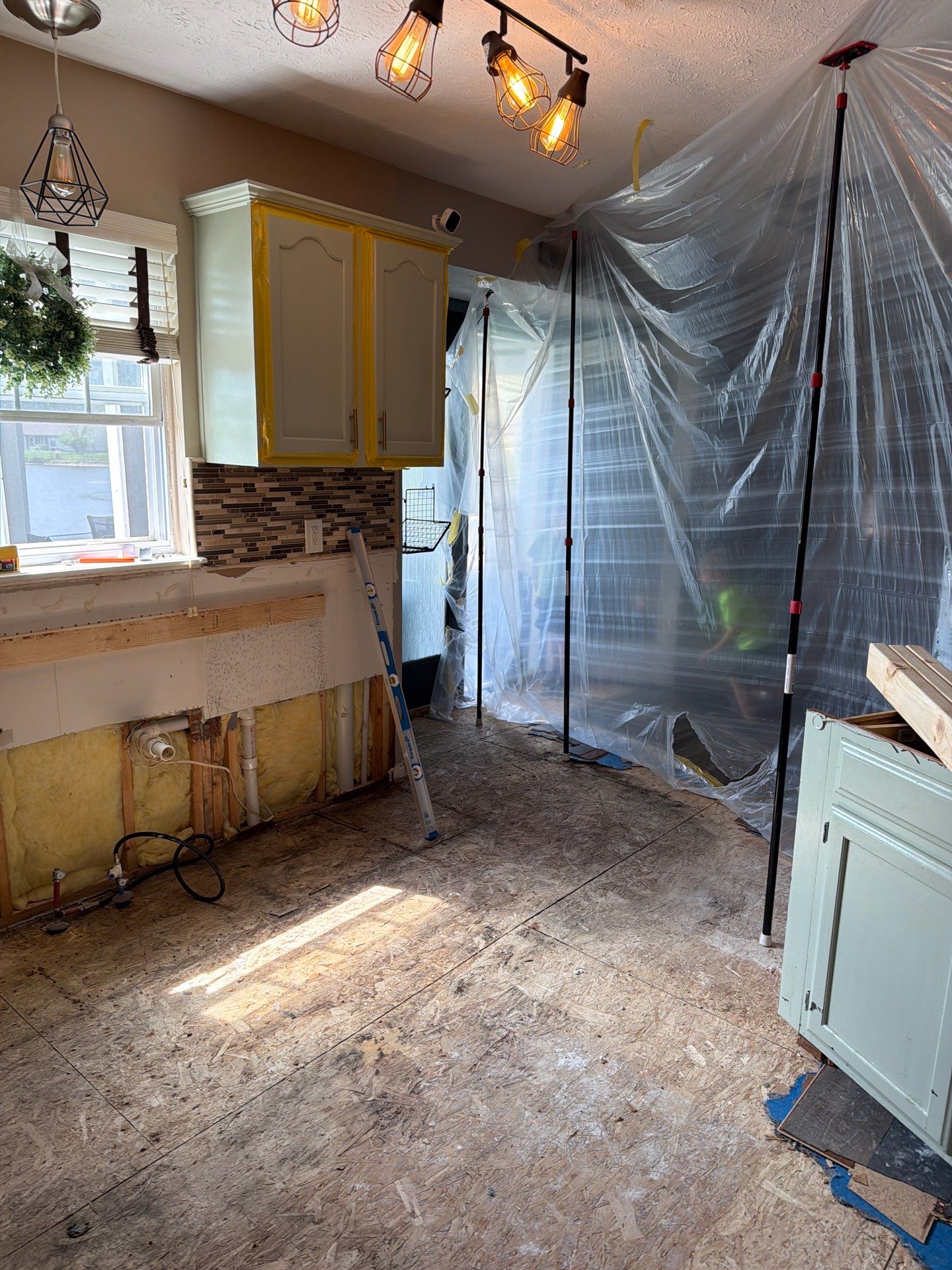
The reason speed matters has nothing to do with the puddle you can see. It is the migration. Within fifteen or twenty minutes, water has typically traveled along the subfloor under the dishwasher cavity, found the gap between the slab or plywood and the cabinet bottom, and started saturating the particleboard edges of your sink base and the cabinet on the opposite side. By the one hour mark it has often reached the hardwood or LVP seams in the adjacent room. Our crews use thermal imaging and pinless moisture meters to map exactly how far it went, which is the same approach detailed in our piece on moisture mapping with thermal imaging. Guessing the boundary is how mold problems start three weeks later.
While the crew is en route, there are a few small actions that pay off later. Open the dishwasher door and pull the lower rack so you can see whether water is still standing inside the tub, which tells you whether the leak is supply side or drain side. Photograph everything before you start moving items, because your insurance adjuster will want documentation of the original scene rather than the cleaned up version. Move small appliances, pet bowls, and anything cardboard off the floor in a six foot radius, since cardboard wicks moisture upward fast and will transfer it to whatever surface it touches next. None of this takes more than five minutes, and it changes the trajectory of the claim and the repair.
Where Dishwasher Water Actually Goes
People assume the water stops at the kitchen, and it almost never does. The subfloor under a dishwasher is usually a single sheet of plywood with a cutout for the unit, and the seams around that cutout are not sealed against water. Anything that pools under the machine has a direct path to the joist bay. From there it follows gravity, which in most Alexandria two story homes means down toward an exterior wall or, in homes with basements, straight through the ceiling drywall below. We get calls every month from homeowners who only noticed the leak because a brown stain bloomed on their basement ceiling overnight.
The materials at risk are predictable. Cabinet toe kicks made of MDF swell within hours and never recover their shape. Engineered hardwood with a thin wear layer cups along the seams nearest the dishwasher, and that cupping locks in even after drying because the glue line has already failed. Drywall behind the dishwasher wicks moisture upward six to twelve inches and becomes a mold substrate within two to three days, which is the same window covered in our explainer on how fast mold grows after water damage. Insulation in the wall cavity holds water like a sponge and has to come out regardless of how it looks from the outside.
The path the water takes also depends on the age and construction style of the home. Older Alexandria houses with original tongue and groove subflooring tend to channel water along the board seams, sometimes carrying it ten or twelve feet from the dishwasher before it finds a place to drop through. Newer builds with OSB subfloors hold water on top longer but swell aggressively at the cut edges, which means the damage is more concentrated but harder to dry without replacement. Homes on slab foundations present their own challenge, because the moisture has nowhere to go but laterally through the bottom plate of the wall, which is how a kitchen leak ends up showing as baseboard staining in the dining room two days later.
Prevention That Pays for Itself
The single highest value habit is replacing the rubber supply line with a braided stainless steel hose, and doing it every seven to ten years whether it looks fine or not. Rubber lines fail from the inside out, and there is no visual warning before they let go. A leak detector placed in the toe kick cavity, the kind that screams when its sensor touches water, costs under thirty dollars and has saved more Alexandria kitchens than any other single device we recommend. Run your dishwasher only when someone is home and awake, never overnight, because an unattended leak running for eight hours is the difference between a repair and a renovation. Once a year, pull the kick plate and look at the floor under the unit with a flashlight, checking for staining, swelling, or a faint mildew smell. If you see any of those, you have a slow leak already, and our walkthrough on hidden water damage from a slow leak covers what to do next.
Beyond the supply line, the drain hose is the second most common failure point and the one most homeowners ignore. It should loop up to the underside of the countertop in what plumbers call a high loop, which prevents dirty sink water from siphoning back into the dishwasher and stressing the door gasket. If your installer skipped that step, the gasket eventually leaks at the bottom corners, and the leak is slow enough that you never see it until the cabinet next door starts to delaminate. Check the loop yourself with a flashlight, and if it is missing, a few zip ties and ten minutes of work will add years to the life of the appliance and the kitchen around it.
One more thing worth saying plainly. If your dishwasher discharge has been backing up into the unit instead of draining out, that water is graywater carrying detergent, food particles, and bacteria, and it should not be handled like clean tap water. Categories matter for how the dry out is done and what materials can be saved versus discarded. When Alexandria Water Restoration arrives in most cases within 2 hours of your call, the first thing we do is identify the water category and the migration path before any equipment goes down. That sequence is what protects the parts of your home you cannot see.